Direct Booking Site for Airbnb Hosts: When It Pays and How to Start
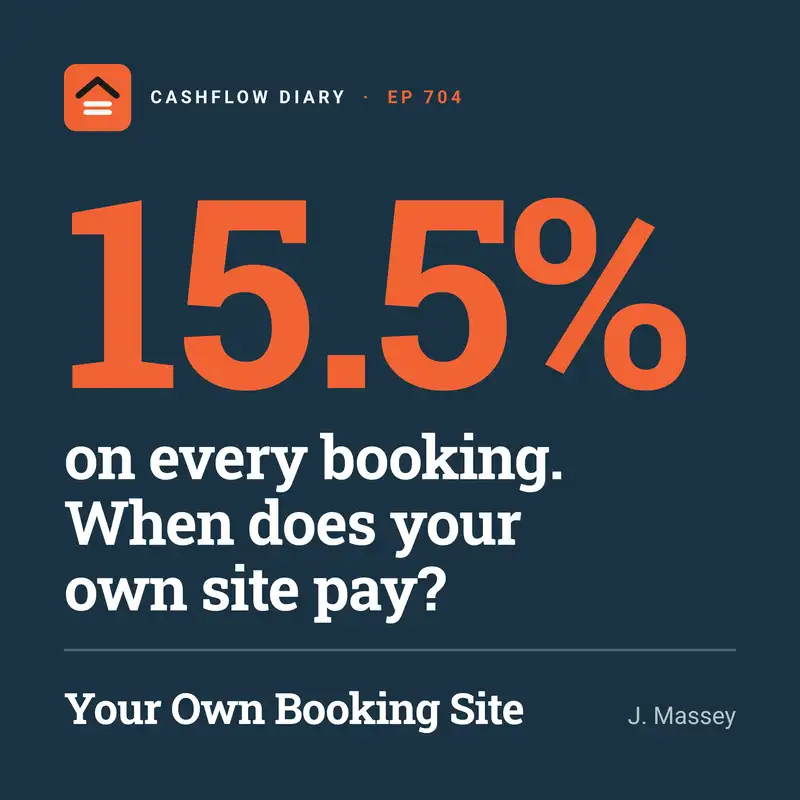
Fifteen and a half percent. That's the fee Airbnb says most hosts on its newer fee structure pay on every booking. On a thousand dollar stay, that's a hundred and fifty five dollars that never reaches your account.
Welcome back to the Cashflow Diary podcast. I'm J. Massey.
Maybe you don't host yet. Maybe you're just tired of the month running out before the money does, and you've been wondering about income that isn't a second job. Sooner or later, anybody who looks at rentals hears the same advice. Build your own booking website. Skip the fee. Keep the money.
Sometimes that's good advice. Sometimes it's a monthly bill for a website nobody visits. Today I'll show you how to tell which one you're looking at, when a direct booking site pays, when it doesn't, and how to start it in the right order. One quick note before we go. Every dollar figure in this episode is a hypothetical example, so you can follow the math. Run it with your own numbers.
Let's start with what the fee is.
On Airbnb's own help pages, under what they call the single fee structure, the whole service fee comes out of the host's payout, and most hosts pay fifteen and a half percent. Airbnb says it's moving all home hosts to that structure. If you're still on the older split fee, you pay a smaller cut and the guest pays the rest on top, so a direct booking mostly saves your guest money. Check which one you're on.
Now the direct side. If a guest books on your own site, you still pay to take their card. Stripe, one of the big payment processors, lists its standard rate as two point nine percent, plus thirty cents, per successful domestic card payment.
So on that thousand dollar stay, Airbnb takes about a hundred and fifty five dollars. The card fee is twenty nine dollars and thirty cents. The difference is roughly a hundred and twenty five dollars per stay.
But that fee buys something. Airbnb says it covers processing guest payments, marketing your listing to guests, and customer support around the clock. Book direct, and all three of those jobs come back to you.
I'm careful with this advice, and I'll tell you why.
I've said this on a live workshop. When someone tells me they're not making enough money, the internet has a standard answer. Get on more platforms. Get a direct booking website. Add early check in and late checkout fees. I think I just summed up the internet.
A website is a door. If nobody knows the door is there, it's a very nice door that costs you money every month.
Back in twenty twenty two, I walked a group through the stages of growing a rental business. Direct booking came up near the end, around the sixteen unit range, when you're testing your systems and building leaders. I even pointed it out on the call. Notice how I didn't mention that until now. Your own direct website comes after you know who your guest is and how they find you. For most people that's not month one.
So when does it pay? It pays when the fees you keep in a year are bigger than what the site costs you to run.
Let's use made up round numbers. Say booking software, a domain, and some damage protection run you a hundred dollars a month. That's twelve hundred dollars a year. And say you keep that roughly hundred and twenty five dollars on each thousand dollar direct stay.
Four direct stays a year, you keep about five hundred dollars and you're down almost seven hundred. Twelve direct stays, you keep about fifteen hundred and you're up about three hundred. The line sits around ten direct stays a year. And that's before your time, before any ads, and before the first payment dispute.
A direct site tends to make sense in three situations. You already have guests who find you without Airbnb, like past direct guests, referrals, or a local business that sends people your way. You run more than one or two units, so the cost spreads out. Or your stays run long or pricey, so the fee you keep is bigger each time.
It tends not to make sense when every guest you have comes from Airbnb search, and you're hoping the website will go find new ones on its own.
Now the part that can cost you the whole business if you skip it. Airbnb's rules.
Airbnb has a page called the Off-Platform and Fee Transparency Policy. Read it yourself. Owning a website isn't on its list. Among the things it prohibits, asking or encouraging users to move current, future, or repeat bookings off of Airbnb. Including links that take people off the platform in listings or messages. Offering discounts to book off of Airbnb. And using guest contact information for marketing.
It also says that in cases of repeated or severe violations, they may suspend or permanently deactivate a listing or an account.
The way I read that, in plain words. A guest who found you on Airbnb is an Airbnb guest. You don't email them your website. You don't slip a card in the welcome book with a discount code. The guest list you can grow is the one you build outside Airbnb, from people who found you some other way.
This is education, not legal advice. Read the policy, and if you're unsure, ask Airbnb.
So where do those other guests come from? This is where I start every time. Who you serve determines all of the rest of it.
On a call in October I was walking through this with someone, and I said it this way. There are people who are specialized at placing. Their entire business is finding a location for a surgeon. That's their whole job. If you serve that one type of guest, and you stick with it, you become known for that type of housing. That's when people come looking for you by name.
Think hospitals that bring in traveling staff. A venue that hosts weddings. A company with contractors in town for three months. Those are relationships, and a relationship can book you directly.
I've said for years, single points of failure don't work. If your whole customer plan is one marketplace, you're exposed. Being on more than one channel helps. Inside the direct book of business, that's where I've always said the money really is. The website is just where that business lands.
One more source people ask about is Google's vacation rental listings. Google's own guide says individual homeowners aren't currently eligible. That route is for property management businesses, so check your setup before you count on it.
Now, what you take on when Airbnb isn't in the middle.
Taxes. In some areas Airbnb collects and sends in local lodging taxes for you, at the time of booking, on Airbnb bookings. On a stay booked on your own site, Airbnb isn't collecting anything. Check with your city and county on how to collect and file.
Protection. Airbnb says hosts are automatically covered whenever they host a stay booked on Airbnb. A stay booked on your website isn't booked on Airbnb. So ask your insurance company, in writing, whether direct stays are covered.
Payments. You take the card, you make the refund calls, and you deal with any chargeback.
Your own rules. Without Airbnb's terms in the way, your rental agreement and your cancellation policy are what you stand on.
And your calendar. A direct booking has to block the same dates on Airbnb right away, or you'll book the same night twice.
None of those is hard by itself. Together, it's a second small business. A rental business takes work, it takes money, and it can lose money. This is education, not financial, legal, or tax advice.
So how do you start? In this order.
First, count your guests outside Airbnb. Write down every past direct guest, referral, and partner who could book you in the next twelve months, without Airbnb. Compare that count to your break even. In my example it was about ten stays a year. If you're short, build the guest source first. The website can wait.
Second, check that your permit and your lodging tax registration cover stays you book yourself.
Third, get your insurance answer in writing.
Fourth, if you already use property management software, see if it includes a direct booking site that syncs with your Airbnb calendar, before you go shopping for a separate one. Connect a payment processor, and test one booking on a blocked date.
Fifth, write your rental agreement, your cancellation policy, and your house rules, and make guests accept them before they pay.
Sixth, launch to people who already know you. Past direct guests, partners, your own audience. And keep the link out of your Airbnb listing and your messages.
Then give it ninety days. Add up the fees you kept, subtract what you spent, and count the hours. That number tells you whether to keep going.
Fifteen and a half percent sounds like money you're losing. For a lot of hosts starting out, it's the price of guests they don't have another way to reach yet. Once you have that other way, the math can flip.
Now your homework. Ten minutes. Write down the name of every guest or partner who could book you without Airbnb. Count them. That number tells you more than any website builder will.
If you'd like a second set of eyes on your numbers and whether a direct site fits your next step... that's what our complimentary one-on-one diagnostic call is for. Go to cashflowdiary.com/diagnostic. Bring your count.
Okay, that's it for today. I'm J. Massey. And this has been the Cashflow Diary podcast.
If this helped, rate the show on Apple Podcasts or Spotify. That helps another person find it.
Quick note... this episode was voiced with my licensed AI voice, built from my own recordings.